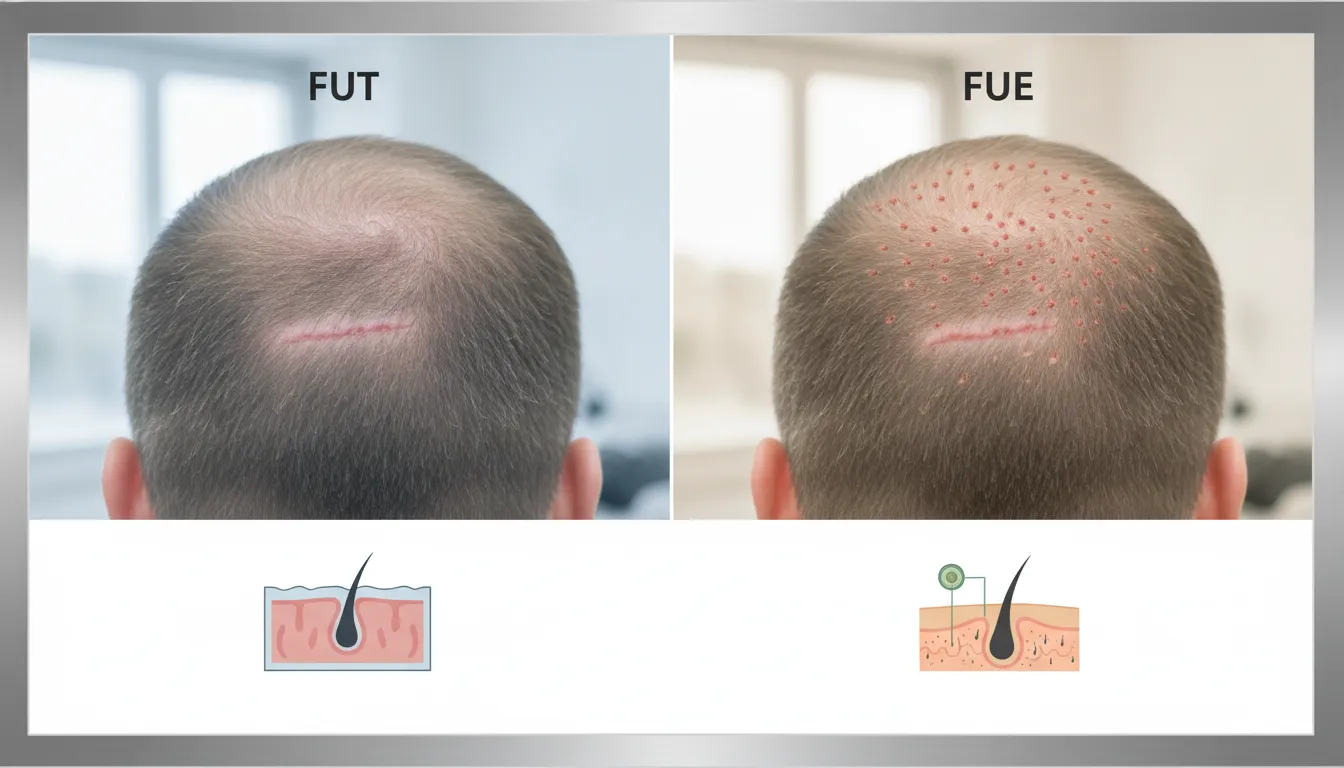
Considering hair-restoration surgery? You may have already come across the terms FUT and FUE, but it can be hard to know what they mean for you. The FUT vs FUE hair transplant comparison starts with how donor follicles are removed: one method uses a strip of scalp, and the other extracts follicles individually. That difference can shape the type of scarring, the way your hair may need to be trimmed, and aspects of recovery. It does not tell you on its own which procedure is best. Your donor supply, pattern of hair loss, hairstyle preferences, and long-term plans all deserve attention before you make a decision.
Key Takeaways
- Know the difference in harvesting methods: FUT removes a strip of scalp and leaves a linear scar; FUE removes follicles individually and leaves small, round scars.
- Choose based on your individual assessment: Discuss your hair-loss pattern, donor supply, scalp health, hairstyle, and recovery needs with a qualified hair-restoration surgeon.
- Plan beyond the procedure: Ask about realistic results, costs, risks, future hair loss, and nonsurgical options so your treatment plan supports your long-term goals.
FUT and FUE Hair Transplants
FUT and FUE are two surgical methods for moving hair follicles from a donor area, usually at the back or sides of the scalp, to areas affected by hair loss. The main difference is how the surgeon removes the follicles. In FUT, the surgeon removes a strip of scalp; in FUE, they extract follicular units one at a time.
Both procedures involve preparing and placing the grafts into areas with thinning hair. The goal is to arrange them in a pattern that suits your natural hair growth, but results vary from person to person. Your hair-loss pattern, donor supply, scalp health, and personal preferences all help shape the treatment plan.
Neither method is right for everyone, and surgery cannot stop hair loss in untreated areas. A consultation with a qualified hair-restoration surgeon can help you understand the options, likely scarring, recovery needs, and realistic outcomes. Use that appointment to ask how the proposed approach fits your current hair loss and long-term goals.
How Surgeons Remove a Strip of Donor Scalp (FUT)
FUT, or follicular unit transplantation, involves removing a narrow strip of hair-bearing skin from the donor area. The surgeon closes the incision with sutures or staples, then a trained team separates the strip into individual follicular grafts under magnification. The surgeon places those grafts into the areas being treated.
FUT leaves a linear scar where the strip was removed. It may heal as a fine line, but its appearance varies and it can become wider or raised. Longer hair may cover the scar, while very short hairstyles can make it easier to see. Ask your surgeon how they plan to close the incision and what scarring may look like for your scalp. This overview of FUT explains the strip-removal process and graft preparation.
How Surgeons Extract Follicular Units (FUE)
With FUE, the surgeon removes follicular units one at a time from the donor area using a small punch tool. The grafts are then prepared for placement in areas with thinning hair. Since FUE does not involve removing a strip of scalp, it avoids a long linear incision. However, it still leaves small, round scars across the donor area.
FUE can require shaving some or all of the donor area, depending on the treatment plan and the clinic’s technique. Ask how much shaving to expect, how the donor area may look as it heals, and how many grafts can be safely removed. Close-cropped hairstyles may reveal the small scars. This comparison of FUE and FUT explains the differences in follicle removal and scarring.
How Surgeons Prepare and Implant Grafts
After harvesting, the surgical team sorts and prepares the grafts, which may contain one or more hair follicles. The surgeon creates small recipient sites in the thinning area, then places each graft to follow the direction, angle, and spacing of natural hair growth. Careful placement helps shape the hairline and create a transition between treated and untreated areas.
FUT and FUE use different harvesting methods, but both depend on careful graft handling and placement. Transplanted hairs often shed before new growth appears, and the timeline and density of growth vary. Some people may need additional treatment to address ongoing hair loss or their goals. Ask your surgeon what results are realistic for you and when you can assess them. Read more about how surgeons prepare and place hair grafts before your consultation.
Who Can Get Hair Transplant Surgery?
Hair transplant surgery may suit people with hair loss who have enough healthy donor hair and a scalp suitable for surgery. During a consultation, the surgeon can assess the cause and pattern of hair loss, donor supply, scalp characteristics, health history, and expectations. Age and the likelihood of continued hair loss matter too, since thinning can progress around transplanted areas.
There is no single technique that works best for everyone. FUT or FUE may be considered based on the area to treat, hairstyle preferences, comfort with a linear scar, recovery needs, and long-term plans. A qualified hair-restoration surgeon can explain the potential benefits and limitations of each option after an individual assessment. This guide to choosing between FUT and FUE outlines factors to discuss with your surgeon.
How Do FUT and FUE Compare?
FUT and FUE are two ways to move hair follicles from a donor area, usually at the back or sides of the scalp, to areas affected by hair loss. With FUT, the surgeon removes a narrow strip of scalp and separates it into grafts. With FUE, the surgeon extracts follicular units individually. Both methods use your own hair, but the different harvesting techniques affect the pattern of scarring, how the donor area may be trimmed, and how a procedure is planned.
There isn’t one method that suits every patient. Your hair-loss pattern, donor hair supply, scalp health, preferred hairstyle, and expectations all factor into the decision. Recovery can also vary based on the size of the procedure and your individual healing. A consultation gives the surgeon a chance to examine your scalp, discuss your goals, and explain what each option may involve. The International Society of Hair Restoration Surgery’s patient guide can help you prepare for that conversation. Use the comparisons below as a starting point, then ask your surgeon how each consideration applies to you.
Donor-Area Scarring
FUT leaves a linear scar where the surgeon removes the strip of scalp. Surrounding hair can often cover it as it grows, but the scar may be visible if you wear your hair very short. Its appearance can vary depending on factors such as your healing, scalp flexibility, and the surgeon’s closure technique.
FUE leaves small, round scars across the donor area rather than one line. These marks may be difficult to see when hair is longer, but FUE is not scar-free. Scars can become noticeable with very short hair or if many follicles are removed. A comparison of FUT and FUE explains the typical differences. Ask your surgeon what scarring may look like with your hair and donor characteristics.
Shaving, Hair Length, and Procedure Visibility
FUT may allow you to keep more of your hair length during the procedure. In some cases, the surgeon can remove the donor strip beneath surrounding hair, which may help conceal the area as it heals. The approach varies, so ask what your donor area is likely to look like immediately after surgery and during recovery.
FUE often requires shaving or trimming part of the donor area so the surgeon can see and extract individual follicular units. Some clinics offer partial shaving or narrow trimmed sections, but this depends on your hair and treatment plan. If you need to maintain a particular hairstyle for work or an upcoming event, raise that early in your consultation. A FUT and FUE method comparison can help you understand common differences, while your clinic can explain its specific approach.
Recovery, Discomfort, and Aftercare
Recovery differs from person to person, and your surgeon is best placed to advise when you can return to your usual activities. FUE creates small extraction sites that heal over time. FUT involves an incision closed with sutures or staples, and you may feel tenderness or tightness in the donor area while it heals. The procedure size and your health can also affect your recovery.
Follow your clinic’s instructions for washing your hair, sleeping, activity, and caring for both the donor and recipient areas. If sutures or staples are used, your surgeon will tell you when they need to be removed. Contact your clinic if you have concerns about pain, swelling, bleeding, or healing. This overview of FUT and FUE recovery describes common differences, but your own care plan should reflect your procedure and medical history.
Graft Yield, Donor Supply, and Future Procedures
FUT may allow some patients to receive more grafts in a single session, which can be helpful when a larger area needs coverage. FUE can also provide a substantial number of grafts, though a larger procedure may take longer or be divided into sessions. The number a surgeon can safely harvest depends on your donor hair’s density and quality, as well as the characteristics of your scalp.
Donor hair is limited, so planning should account for possible future hair loss and treatment. Removing too many follicles can leave visible thinning in the donor area and reduce options later, regardless of technique. A surgeon should assess your current hair loss and discuss how it may progress before estimating graft numbers. Bernstein Medical’s comparison of FUT and FUE discusses how the harvesting methods affect planning. Ask how your surgeon will preserve donor hair for the long term.
Results, Limits, and the Surgeon’s Role
Both FUT and FUE can produce natural-looking results when the procedure is planned for the patient and grafts are placed with care. The surgeon considers factors such as hairline shape, hair direction, and the density that can be achieved with your available donor hair. Results vary, and a transplant cannot recreate every lost hair or guarantee a particular level of fullness.
A transplant also does not stop hair loss in untreated areas. Your native hair may continue to thin, so your treatment plan may need to address future changes. Ask to see examples of patients with hair-loss patterns similar to yours, and clarify who will perform each part of the procedure. The ISHRS patient guide offers useful background for your consultation. An experienced hair restoration surgeon can explain likely outcomes, risks, and whether a surgical or nonsurgical approach best fits your needs.
Weigh the Benefits and Trade-Offs
FUT and FUE both move hair follicles from a donor area, usually the back or sides of the scalp, to areas affected by hair loss. They differ in how the grafts are collected, the pattern of scarring, and what recovery may involve. Consider these trade-offs alongside your hair-loss pattern, donor supply, hairstyle preferences, and surgeon’s advice.
FUT: Linear Scarring and Efficient Graft Harvesting
With FUT, the surgeon removes a strip of scalp from the donor area and separates it into individual grafts for transplantation. This method may provide many grafts in one session, which can be useful for people who need broader coverage. The donor wound is closed with sutures or staples.
FUT leaves a linear scar. It may heal as a fine line, but its appearance varies, and some scars become wider or raised. Longer hair may cover it, while very short styles can make it more noticeable. Temporary tightness around the donor area is also possible during healing. Review the differences between FUT and FUE with your surgeon, including how your graft needs and preferred hairstyle affect the choice.
FUE: Small Scars and More Hairstyle Options
With FUE, the surgeon removes follicular units one at a time. This leaves small, round scars across the donor area rather than one linear scar. The marks may be hard to see after healing, but FUE is not scar-free. Repeated procedures can make the dots more noticeable and may reduce the supply of healthy donor follicles if too many are removed.
Since FUE avoids a long strip scar, it may offer more flexibility for people who prefer shorter hairstyles. The outcome depends on factors such as hair density, healing, and how grafts are distributed. Ask your surgeon where scars may show and how they will protect the donor area. FUT and FUE scarring differs in pattern, but both methods leave lasting marks.
Healing, Risks, and Long-Term Results
FUE extraction sites often heal within several days, and some patients can return to light activity after a few days. FUT involves a sutured or stapled wound, which may cause temporary tightness and need extra care as it heals. Recovery varies, so follow your clinic’s instructions on washing your scalp, exercising, and protecting treated areas. This comparison of FUE and FUT recovery describes common differences between the procedures.
Both methods carry risks, including bleeding, infection, scarring, and grafts that do not grow as expected. Results depend in part on the surgeon’s skill, donor-hair quality, and graft placement. A transplant does not prevent hair loss in untreated areas, so discuss how your treatment plan accounts for future changes.
How Much Does a FUT or FUE Hair Transplant Cost?
Hair transplant costs vary from patient to patient. Your estimate may depend on the number of grafts needed, the recommended technique, the clinic’s fees, and the care included before and after surgery. In the United States, a hair transplant session often costs between $6,000 and $15,000 or more. Treat this as a general range, not a personalized quote.
During a consultation, ask the surgeon to explain the estimate and how it relates to your hair-loss pattern, donor hair, and treatment goals. Comparing the details behind each quote can help you understand what you’re paying for, not just which option has the lowest total.
How Graft Count, Technique, and Clinic Fees Affect Cost
The number of grafts is a major factor in your estimate. A graft contains one or more hair follicles, and the number you may need depends on the area being treated and your desired coverage. The technique also affects the price. FUT often costs about $2 to $6 per graft, while FUE may cost around $5 to $10 per graft because the surgeon removes follicles individually. These figures are general estimates, and clinic pricing can differ. Read about cost differences between FUT and FUE.
Fees may also reflect the surgeon’s experience, clinic location, and services provided. Ask for an itemized estimate that lists the proposed graft count, technique, and any additional charges. Your surgeon should explain why the recommended approach suits your hair and donor supply, rather than basing the decision on price alone.
Compare Quotes, Included Care, and Future Treatment Costs
Ask each clinic what the quote covers. It may include follow-up visits, post-operative care, or other treatments, but services vary. Request the details in writing, and ask who will perform each part of the procedure. This makes it easier to compare estimates and identify costs that may be billed separately.
It’s also worth discussing how surgery could affect future treatment options. Donor hair is limited, and FUT and FUE use it differently. With FUE, removing too many follicles from a donor area can leave it visibly thin. Ask how the surgeon plans to manage your donor supply, especially if hair loss may continue. Learn how each method uses donor hair and discuss what the information means for your long-term plan.
Choose a Method That Fits Your Hair-Loss Pattern and Goals
FUT and FUE are two ways to collect donor hair for a transplant. Neither is the right choice for everyone. Your hair-loss pattern, the amount and quality of hair available in the donor area, scalp health, preferred hairstyle, and recovery priorities all help determine which approach may suit you. A surgeon should assess these factors before recommending a procedure.
Consider what you may need in the future, not only what you hope to change now. Hair loss can continue after a transplant, and surgery does not prevent thinning in untreated areas. Because donor hair is limited, your treatment plan should account for possible future procedures and preserve the donor area where possible. The Bosley comparison of FUT and FUE also points to donor supply, hairstyle preferences, and recovery goals as factors in choosing a method.
Before deciding, tell your surgeon what matters most to you. You might want to wear your hair very short, avoid a linear scar, restore a larger area, or minimize time away from your usual routine. Ask why a particular technique is being recommended, what results are realistic for your situation, and whether nonsurgical treatments should be part of the plan. The recommendation should reflect your assessment, preferences, and long-term goals.
Consider Hair-Loss Progression, Donor Supply, and Scalp Health
Your surgeon will assess the extent and pattern of your hair loss, the density of hair in the donor area, and the condition of your scalp. These details help determine whether surgery is appropriate and how many grafts may be available. If your hair loss is still progressing, discuss how future thinning could affect the appearance of the transplanted area.
Donor hair is limited, so using it thoughtfully matters, particularly if you may want another procedure later. Scalp conditions or other health factors may affect whether surgery is suitable or when it should take place. Share your medical history, medications, and any scalp symptoms during your consultation. Ask how the surgeon calculated your graft estimate and how the plan will preserve donor hair over time.
Match the Method to Your Hairstyle and Recovery Needs
Consider how you usually wear your hair and whether you are comfortable changing your style during recovery. FUE leaves small, dot-like scars in the donor area, while FUT leaves a linear scar where the strip was removed. If you prefer very short hair, ask how visible scars may be with each method. Your scalp characteristics and the surgeon’s assessment also matter. The FUE and FUT overview from Dr. Adrian Lo discusses how hairstyle preferences, graft needs, and recovery considerations can shape the choice.
Recovery varies from person to person, and neither technique guarantees a quick or comfortable healing period. Ask about aftercare, activity restrictions, and when you can return to work, exercise, and your usual hair-care routine. Make sure you understand what recovery may involve before scheduling surgery.
Set Realistic Expectations and Discuss Nonsurgical Options
A hair transplant can add hair to selected areas, but it cannot create unlimited density or stop hair loss elsewhere. Results take time to develop, and the outcome depends on factors such as donor hair, scalp characteristics, graft placement, and surgical skill. Ask what level of coverage is realistic for you and when you may begin to see changes.
Nonsurgical treatments may help manage ongoing hair loss, either instead of surgery or as part of a broader plan. Ask a dermatologist or hair-restoration specialist about the potential benefits, risks, and limits of options suited to your health and goals. The Bernstein Medical guide to FUT and FUE emphasizes the importance of considering long-term goals alongside the procedure itself.
Questions to Ask a Hair Transplant Surgeon
A consultation should help you understand what surgery may achieve, what trade-offs to expect, and whether the plan fits your hair loss and preferences. Bring your questions, and ask the surgeon to explain anything that is unclear. A thoughtful discussion should cover the surgeon’s experience, donor hair, recovery, and how to manage hair loss over time.
Ask About Experience, Graft Estimates, and Donor-Area Management
Ask who will perform each part of the procedure and how much experience they have with FUT and FUE. Request an estimated graft count, and ask how the surgeon determined it. The estimate should reflect your hair-loss pattern, hair characteristics, goals, and available donor hair, not just the area you want to cover.
Discuss where donor hair will come from, how much can be safely removed, and how the area may look after healing. Ask to see results from patients with similar hair loss and hair type, including images taken well after surgery. The American Academy of Dermatology’s overview of hair transplant surgery offers helpful background for preparing questions.
Discuss Scarring, Recovery, Risks, and Follow-Up Care
Ask what type of scar to expect and how visible it may be with your usual hairstyle. FUE creates small extraction scars, while FUT leaves a linear scar; the appearance can vary from person to person. Find out how long you may need to take off work, when you can wash your hair or exercise, and what aftercare instructions you’ll need to follow.
Ask about possible complications, such as infection, bleeding, changes in sensation, visible scarring, or less growth than expected. Clarify which symptoms warrant a call to the clinic, who to contact with concerns, and what follow-up visits are included. This FUT and FUE comparison provides general information, but your surgeon should explain what recovery may look like for you.
Review Long-Term Treatment Plans and Alternatives
A transplant moves existing hair to another area, but it does not prevent hair loss from continuing elsewhere. Ask how your hair may change over time and whether medication or other nonsurgical treatments may be suitable. Discuss their potential benefits, risks, and costs with your surgeon or dermatologist.
Ask how the proposed procedure will preserve donor hair for the future and whether you may need another session. The right plan depends on your hair-loss pattern, donor supply, hairstyle, and recovery preferences. Bernstein Medical’s discussion of FUE and FUT explains why a surgeon may consider different techniques at different stages. Request a written plan that covers the recommended approach, alternatives, expected limits, and follow-up care.
Related Articles
- FUE Hair Transplant
- FUT Hair Transplant
- Bio-Sapphire Hair Transplant
- PRP Hair Restoration
- Hair Restoration
Frequently Asked Questions
Is FUE better than FUT?
Neither technique is best for everyone. FUE may suit people who prefer to avoid a long linear scar, while FUT may be considered when a larger number of grafts is needed. Your surgeon can recommend an approach after assessing your hair loss, donor area, hairstyle preferences, and health.
Will a hair transplant leave scars?
Yes. FUT usually leaves a line-shaped scar, while FUE leaves small, round scars in the donor area. How noticeable they are depends on your healing, hair length, and how the procedure is performed. Ask your surgeon what to expect with your preferred hairstyle.
How long does it take to see hair transplant results?
Transplanted hairs often shed before new growth begins. Growth and the time it takes to assess the result vary between people. Your surgeon can explain the expected timeline for your procedure and when to discuss whether the outcome meets your goals.
Does a hair transplant stop future hair loss?
No. Surgery moves follicles to selected areas, but hair loss may continue in untreated areas. Ask your dermatologist or hair-restoration surgeon whether ongoing treatment may help manage future thinning.
How can I compare hair transplant cost estimates?
Ask for a written, itemized estimate that includes the proposed technique, graft count, surgeon and clinic fees, follow-up visits, and any additional costs. Make sure you understand who performs each part of the procedure and why the recommended plan fits your needs.