
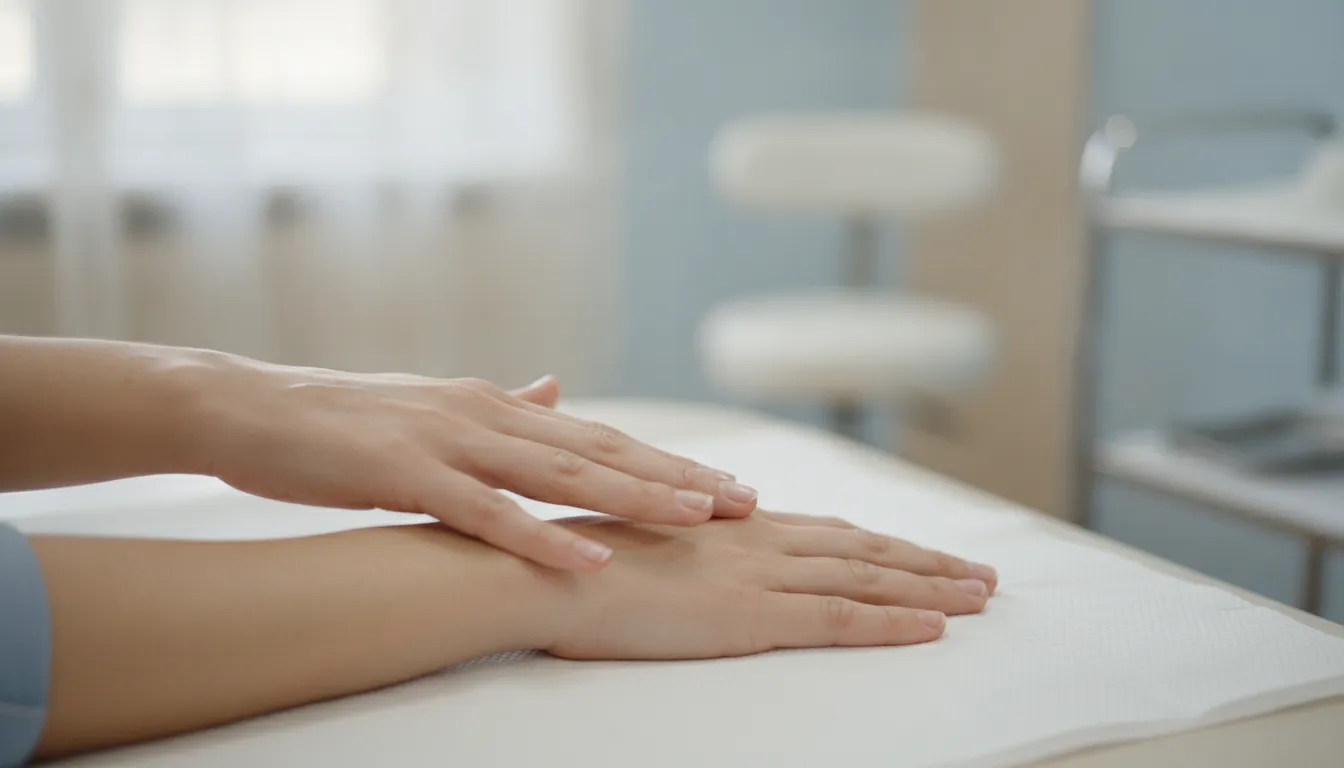
Cracked, itchy hands that sting after washing are a common reason adults look up hand eczema treatment. Moisturizer helps ordinary dryness. It is often not enough once the skin burns, splits, or weeps. Hand eczema, also called hand dermatitis, affects the hands and wrists and can make work and daily chores painful. There is no single cure, and the plan depends on whether soap, water, an allergen, or a long-standing skin barrier problem is driving the flare.
Call (727) 888-0900 to schedule a hand eczema visit
This guide covers adult hands. It explains how the rash differs from dry skin, what tends to set it off, and a barrier routine you can start today. It also covers when a dermatologist should choose the medicine. For a broader look at eczema on the body, see the eczema page. That page is the general overview. It does not replace a hand-specific plan.
How hand eczema differs from dry hands
Dry winter skin usually feels tight and improves when you moisturize. Hand eczema keeps going. The American Academy of Dermatology describes dry, chapped skin as an early sign. Later signs include red, dark brown, purple, or gray patches, scaly itchy skin, burning, and itchy blisters. Deep cracks, bleeding, weeping, and crusts or pus show up when the skin is badly inflamed. Dawn Davis, MD, FAAD, is a board-certified dermatologist quoted by the Academy. She puts the practical test this way. If your hands are extremely dry and painful, and moisturizer through the day is not helping, hand eczema is possible. Without treatment and prevention, it can worsen.
Color is easy to miss. On lighter skin the rash often looks red. On darker skin it may look dark brown, purple, or gray, so itch, scale, and cracks matter more than a single shade. Cracks between the fingers are a frequent complaint. Leftover cleanser, water, and friction collect there, and the skin splits. That pattern still needs an exam. A fungal infection, a contact allergy, or another rash can look similar, and a blog cannot tell them apart.
The National Eczema Association estimates that about 14.5% of people worldwide experience hand eczema. Jobs that keep the hands wet raise the odds. Nurses, hair stylists, plumbers, food workers, machinists, and people who handle solvents, detergents, or cement are named often in dermatology guidance. Adults who had atopic dermatitis as children are also at higher risk. The hands are used all day, so a small flare can limit typing, cooking, and sleep even when the rest of the skin looks fine.
What sets hand eczema off
Hand eczema is not one disease with one cause. Effective treatment starts by finding what the skin keeps meeting. The Academy notes that anything that irritates the skin can start it, including water, and that not drying the hands fully is enough for some people. Sweat can flare one person in warm weather. Cold, dry air can flare another. A trigger that matters for you may not matter for the next patient.
Three patterns come up often. Irritant contact dermatitis follows repeated soap, detergent, sanitizer, solvents, or wet work. The skin barrier wears down. It is not always an allergy. Allergic contact dermatitis follows a specific allergen, such as latex or rubber in gloves, fragrance, a preservative in a cream, or a metal in jewelry. Atopic hand eczema is tied to atopic dermatitis and a barrier that was already fragile. A dermatologist sorts these out from the rash, your job, and your products. Guessing at home often means avoiding the wrong thing.
Small, clear, very itchy blisters on the sides of the fingers are a different pattern, often called dyshidrotic eczema. It can overlap with wet work, but it has its own treatment questions. If that is the main problem, ask about it at the visit rather than treating every hand rash the same way.
Patch testing is the tool dermatologists use when an allergy is likely and the history is crowded. The American Academy of Dermatology describes the workup as an exam plus questions about health, job, hobbies, and the products you use. Testing is added when those answers are not enough. A negative test does not mean the hands are fine. In one Academy case, a printing-press operator was not allergic to the chemicals that were tested. The rash tracked to a solvent he used while cleaning the press. The useful clue was the task, not a long list of product names.
A hand care routine that protects the barrier
Medicine works better when the barrier is not under constant attack. These steps come from Academy and National Eczema Association guidance. They are a starting routine, not a prescription.
- Wash with lukewarm water and a gentle, fragrance-free cleanser. Skip very hot water and wash only as often as the job requires.
- Rinse fully, especially between the fingers, where cleanser sits and cracks start.
- Pat dry with a clean towel or paper towel. Do not let the hands air-dry, and do not rub them hard.
- Apply a fragrance-free cream or ointment within a few minutes, and again after every wash. Ointments tend to seal better than thin lotions on cracked skin.
- Use cotton or vinyl gloves for wet work and cleaning. Avoid latex if it has flared your skin. Wear cotton liners under waterproof gloves so sweat does not sit on the rash.
- Take rings off before washing or wet work. Soap and water collect under the band and keep the skin damp.
- For very dry nights, apply a plain ointment and wear clean cotton gloves while you sleep.
Gloves help only when they stay dry inside. Waterproof gloves trap sweat. Sweat is its own irritant, so limit each wet task and change damp liners. Cotton liners can be washed and rotated through the day. Powdered gloves and latex are common flare sources for health care and salon work. Vinyl or nitrile with a cotton liner is the setup many dermatologists suggest first. Confirm that choice at your visit if you already know a glove material bothers you.
Work around the sink needs the same habits as work around chemicals. Keep a fragrance-free cream at the station and apply it after you dry your hands, not an hour later. Alcohol sanitizer is sometimes less damaging than soap and water when the hands are not visibly soiled, but it still stings on open cracks. If sanitizer is required, let it dry, then moisturize. Do not layer sanitizer on a thick ointment and expect either one to work.
Bring the products you already use, including sanitizer, dish soap, and creams labeled natural. Fragrance and preservatives hide in items that feel gentle. If a cream stings every time, stop it and ask before you add another active ingredient. Home remedies that promise a fast or permanent cure are a poor trade for a barrier that is already open.
A simple order for each hand wash
- Wet the hands with lukewarm water and use a small amount of gentle cleanser.
- Rinse the finger webs until the skin no longer feels slippery.
- Pat dry, including between the fingers and around rings you had to wear.
- Apply fragrance-free cream or ointment while the skin is still slightly damp.
- Put on clean gloves only after the product has sunk in, if the next task requires them.
How a dermatologist treats hand eczema
Avoiding the trigger is the treatment that lasts. That is not always possible. Wet work may be part of the job, or an allergen may show up in many products. The visit then turns to protection and to medicine matched to the severity. Dermaclinique is a physician-owned dermatology practice. A clinician looks at the hands, asks about work and products, and decides the next step. That may be a barrier plan, a prescription, testing, or care for infection. The same cream is not right for every patient.
| Approach | What it is for | What to know |
|---|---|---|
| Barrier care | Dryness, frequent washing, and mild flares | Fragrance-free ointment or cream after every wash. This is the base of every plan. |
| Topical steroids | Inflamed, itchy, cracked skin | A dermatologist chooses the strength and how long to use it. Hands often need more than a weak over-the-counter cream, but stronger medicine is not a daily forever plan. |
| Non-steroid topicals | Sensitive skin or longer-term control | Options such as tacrolimus or pimecrolimus may be considered when steroids are a poor fit. They are prescription decisions, not a swap you make alone. |
| Patch testing | A rash that keeps returning despite good care | Testing looks for allergens in gloves, metals, fragrances, and preservatives. A negative test can still leave an irritant problem. |
| Phototherapy or systemic medicine | Severe or widespread disease that topicals do not control | Reserved for selected patients after an exam. These are not first steps for a new, limited hand rash. |
The National Eczema Association notes that a flare often lasts about three to four weeks and can return if the exposure continues. That timeline is a reason to treat early. It is not a promise that every hand clears on a calendar. Thick skin on the palms also absorbs moisturizer slowly, which is why a thin lotion can seem to do nothing. An ointment, used often, matches that thicker skin better than a spray or gel.
Infection changes the plan. Crusting, pus, spreading redness, or pain that is new needs a clinician, not another layer of cream. Antibiotics are for infection a clinician confirms. They do not treat the eczema itself. Over-the-counter hydrocortisone can calm a mild itchy patch for a short time. It often fails on thick, cracked palms. Do not keep increasing how often you apply it while the cause stays in place.
Do not start a leftover steroid from another rash, and do not use a strong steroid on broken skin for weeks without a plan to stop. Tell the clinician if you are pregnant, nursing, or treating a child. Those situations need their own review and are outside this adult hand guide.
Hand eczema treatment at a dermatology visit
A hand visit is narrower than a general skin check. Bring a list of soaps, sanitizers, gloves, and creams, and note whether the rash eases on days off. That history often matters more than a photo. The clinician examines the palms, the backs of the hands, the wrists, and the finger webs. They look for scale, blisters, and signs of infection. If an allergy is plausible, patch testing may be planned for a later visit rather than done the same day.
Expect a plan you can follow at work, not only at home. That can mean a cleanser you can use between patients or clients, a glove setup that does not trap sweat, and a clear stop date for any steroid. Ask what should improve in two weeks and what should bring you back sooner. Improvement is less itch, fewer new cracks, and skin that can tolerate washing. It is not a promise that the hands will never flare again.
Hand eczema treatment is individualized. Two people with similar cracks may leave with different medicines because one has an irritant from the sink and the other has an allergen in a glove. Neither plan is a spa service, and neither replaces the barrier steps above.
When cracked hands need a visit
Schedule a visit if moisturizer and gentle care have not helped. Come in if cracks bleed, if blisters keep returning, or if the rash limits your job. Also come in if you suspect a glove, a sanitizer, or a workplace chemical. Go sooner for pus, fever, or a rash that is spreading. Those can be signs of infection. People who wash their hands for a living should not wait until the skin is too painful to work. A short history of the workday often points to the cause faster than another tube of cream.
Dermaclinique sees patients at two offices. St. Petersburg is at 3085 Dr. MLK Jr. St. N, St. Petersburg, FL 33704. Clearwater is at 510 E. Druid Road, Suite A, Clearwater, FL 33756. Both use (727) 888-0900, and the published office hours are Monday through Friday, 8:30 a.m. to 5 p.m. You can book from the schedule page or ask a question through contact. Medical skin concerns like this sit with medical dermatology, not a one-time spa treatment.
Call (727) 888-0900 to book a hand exam in St. Petersburg or Clearwater.
Frequently asked questions
What is the best thing to put on hand eczema?
Start with a fragrance-free cream or ointment right after washing, and use it through the day. That repairs the barrier. If the skin is still inflamed, a dermatologist may add a topical medicine. There is no single best cream for every hand.
Why does the skin crack between my fingers?
Water, soap, and sanitizer collect in the finger webs and break the barrier. Rinsing well, patting dry, and moisturizing those spaces helps. Deep or bleeding cracks should be examined so infection is not missed.
Can hand eczema be cured permanently?
No. Dermatology groups describe control, not a cure. Flares often settle when the trigger is found and the barrier is protected, then return if the exposure continues. A permanent home cure is not a realistic claim.
Do I need allergy testing for hand eczema?
Not always. Many cases are irritant, from water and soap, rather than a true allergy. Patch testing is useful when the rash persists or a glove, fragrance, metal, or workplace chemical is suspected.
When should I see a dermatologist?
See one if pain, cracks, blisters, or work limits continue after a careful barrier routine, or right away if the skin weeps, crusts, or seems infected. The visit is where the medicine and any testing are chosen.