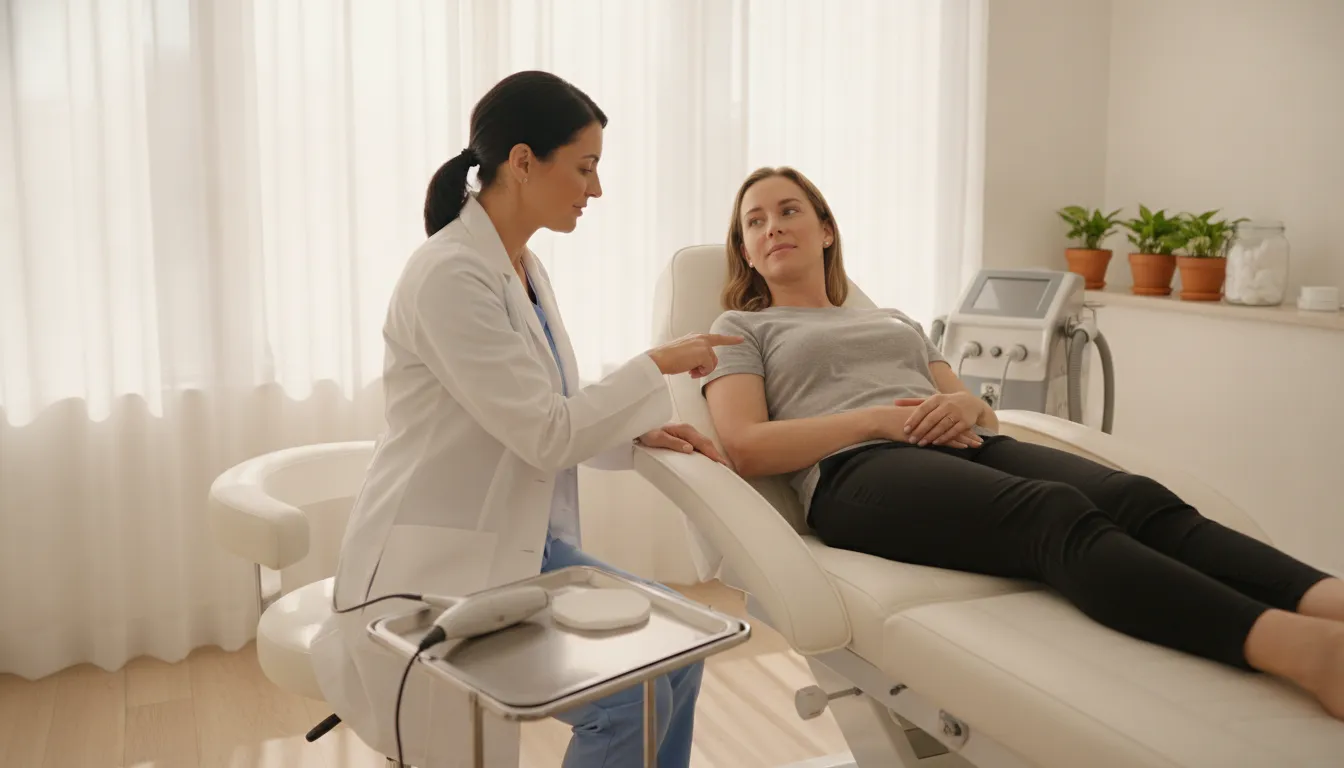
Microneedling with PRP vs microneedling without PRP is a choice between the same collagen-stimulating visit and that visit plus a concentrate made from your own blood. Both are offered at Dermaclinique for texture, tone, fine lines, and scars. They are not the same appointment. Neither one is automatically the stronger choice. The right fit depends on the concern, how you heal, and whether a blood draw belongs in the plan.
Schedule a consultation in St. Petersburg or Clearwater
This guide stays on the comparison. It covers what changes in the room, who each option tends to suit, how the first days differ, and the safety limits a physician should review with you. Pricing for the combined treatment lives on a separate guide. The full service details stay on the treatment pages.
What changes in microneedling with PRP vs microneedling without PRP
Standard microneedling and microneedling with platelet-rich plasma start from the same idea. A device with fine needles makes controlled channels in the skin, and those channels signal repair. Over a series of visits, that repair can raise collagen and elastin.
Dermaclinique uses the SkinPen Precision System for microneedling, which is an FDA-cleared microneedling device. The visit is planned by Dr. Priya Nayyar, a board-certified dermatologist who reviews history before any device touches the skin.
The visit without PRP
Without PRP, the visit is the device plus a hydrating serum. Dr. Nayyar reviews your history, medications, and allergies, then explains the procedure, downtime, and follow-up. A numbing gel goes on first and is removed once it takes effect. A hydrating serum is applied, and SkinPen is passed over the treatment area.
The device looks like a pen covered with very fine needles. Those needles create narrow channels in the dermis and epidermis, which triggers the skin’s own healing and supports collagen and elastin. The serum is there for comfort and slip. It is not a platelet concentrate.
The visit with PRP
With PRP, the needles are only half of the visit. A small blood sample is drawn and spun so the platelet portion can be separated from most of the red cells. After microneedling, that platelet-rich plasma is applied to the treated skin so growth factors can enter through the fresh channels.
The practice describes the combined visit as about an hour, including numbing, and you may have mild redness or swelling afterward. On the microneedling with PRP page, most people do best with 3 to 4 sessions spaced 4 to 6 weeks apart. Some people notice texture, tone, and firmness after the first treatment, but a series is still the usual plan for a fuller change.
Session count for microneedling alone is individualized. The microneedling page says you may need more than one treatment, and the number follows age and skin quality rather than a fixed series. That is a real difference when you are choosing, not a small footnote.
What the research can and cannot say
One limit matters before you compare published studies: there is no single recipe for cosmetic PRP. Spin speed, platelet concentration, and activation differ between clinics and between papers. A study that used one method does not prove the same margin at every office. At this practice, the plan is set after an exam rather than copied from a protocol in a journal.
PRP prepared this way is also not an FDA-approved drug for facial rejuvenation. The device clearance and the blood product are separate questions, and a physician-owned dermatology practice should say that plainly. Then you and the physician can decide whether the add-on still makes sense for your skin.
Who should choose microneedling with or without PRP
Microneedling alone is the simpler visit. It suits people who want texture, early fine lines, dullness, or mild uneven tone. It also suits people who would rather skip a blood draw. The practice lists several reasons someone might consider it. Those include scars, uneven tone, creases, fine lines, stretch marks, and loss of firmness.
Florida sun and humidity show up in that list for a reason. Uneven tone and blotchy color are common reasons patients ask about this treatment. Because no foreign filler is placed, it is often the first conversation for patients who want a treatment built on their own healing response. The practice describes it as suitable across skin types. Pigment risk is still an exam question, especially after sun exposure.
Microneedling with PRP is the visit to discuss when the concern is more than maintenance. The combined page names a longer list. It includes fine lines, acne scars, uneven texture and tone, stretch marks, enlarged pores, sun damage, dull skin, and loss of firmness. The added step is the platelet concentrate, not a deeper needle. People who want that growth-factor step, and who can do a blood draw the same day, are the usual candidates.
Research is strongest for acne scars, and even there it is not a promise. A 2021 split-face study followed 36 patients through four monthly sessions. One side received microneedling plus PRP. The other side received microneedling alone. Both sides improved. The PRP side had a larger drop in scar scores. Patients rated that side higher. Physician scores did not show a clear gap between sides (Gupta, Barman, and Sarkar, Journal of Cutaneous and Aesthetic Surgery).
A broader scoping review describes the combination as useful for acne scars. It also notes that PRP preparation is not standardized (Meghe and colleagues, Journal of Pharmacy and Bioallied Sciences, 2024). Read that as direction. It is not a guarantee that your scars will change by a set amount. Studies also differ in needle depth, session count, and how PRP was prepared. That is why a published percentage should not be treated as your expected result.
For fine lines and general glow, the evidence that PRP outperforms the device alone is thinner. Many patients do well with SkinPen and a serum. They can add PRP later if texture or scars are still the main issue. You do not have to decide the whole series on day one.
Some histories should pause the conversation. Active acne, an infection in the treatment area, a bleeding or platelet disorder, recent isotretinoin, pregnancy, and a tendency to form keloids all belong in that group. Those are exam questions. You cannot clear them from a blog.
This comparison is facial skin only. PRP used on the scalp is a different treatment with a different goal. If hair density is the question, that belongs on the hair restoration pages, not in this decision.
Recovery and safety for both microneedling options
Downtime is short for both, and it is not identical. After microneedling alone, you can return to normal activities the same day. Irritation often settles within 24 hours. You also get a list of products to avoid while the skin is regenerating.
After microneedling with PRP, mild redness or swelling can last a few days rather than a single day. Most patients still get back to routine activities quickly. Plan on pink skin either way. Do not plan on a same-day event if you want a completely settled face. Makeup timing and exercise limits should come from your aftercare sheet, not from a general blog.
| Question | Microneedling without PRP | Microneedling with PRP |
|---|---|---|
| What is applied. | Hydrating serum, then SkinPen. | SkinPen, then platelet-rich plasma from your blood. |
| Extra step. | None. | A blood draw and a spin come before the plasma is applied. |
| Best first conversation. | Texture, early lines, dullness, or no blood draw. | Acne scars, a marked texture change, or the growth-factor step. |
| Early recovery. | Irritation often settles within 24 hours. | Mild redness or swelling often lasts a few days. |
| Series. | More than one visit is common. The count follows your skin. | Often 3 to 4 visits, spaced 4 to 6 weeks apart, then adjusted. |
Results from either visit build over weeks, not overnight. Collagen remodeling is slow. The combined page says many people notice texture, tone, and firmness after the first treatment. A series is still used for a fuller change. Microneedling alone is described the same way. More than one session is common when the goal is a visible shift. Neither page promises a scar-free or line-free face. This article will not either.
Expect the change to be gradual. Pores, fine lines, and shallow scars tend to soften across the series rather than vanish after one pass. Deeper scars may improve and still remain visible. Sun protection between visits matters as much as the device. Fresh channels and Florida sun are a poor mix. Your physician will tell you when sunscreen and normal products can restart.
Safety favors a medical setting over a device bought for home use. The practice warns that at-home rollers can use poor materials and needles that are not sterile. That raises infection risk. Commercial home devices are also less precise. In the office, numbing, a cleared device, and a physician reviewing your history are the controls.
PRP uses your own blood, which lowers the chance of an allergy to the plasma itself. It does not remove every risk. Needle passes can still cause prolonged redness, bruising, infection, or pigment change. That risk rises if aftercare is skipped or the skin was not a good candidate. The FDA’s consumer update on microneedling devices is a useful plain-language check on benefits and risks before you book.
A sensible recovery sequence looks like this:
- Leave the skin alone for the first evening unless your physician gives a specific ointment.
- Use a gentle cleanser and skip acids, scrubs, and retinoids until you are cleared.
- Apply the sunscreen your physician recommends once the skin can tolerate it.
- Skip pools, saunas, and heavy workouts for the window named at your visit.
- Call the office if redness, pain, or drainage worsens instead of fading.
Sunscreen, a gentle cleanser, and a pause on irritating products are the usual themes. Exact product stops come from your visit, not from a general list. If you are prone to dark marks after inflammation, say so before the first session. Depth and aftercare can be adjusted. They should not be guessed.
How a St. Petersburg or Clearwater visit decides
The comparison ends in an exam, not in a blog. Dermaclinique is a physician-owned dermatology practice. Offices are in St. Petersburg and Clearwater. A consultation is where Dr. Nayyar, or the clinician she assigns, looks at your skin. Scar depth, pigment risk, medications, and your goal all matter. Maintenance and a more involved series are different plans.
Bring the concern you actually want changed. A faint texture issue and a field of acne scars can lead to different recommendations. Both can be treated with needles. They do not automatically get the same plan. Photos of old scars and a list of current products are useful to bring. So is a note about any treatment you have already tried.
If you are comparing this pair with other treatments, say so. Chemical peels, laser resurfacing, and radiofrequency microneedling each have their own role. They answer a different question than whether to add PRP to a SkinPen visit. PRP therapy on its own, placed by injection rather than through microneedling channels, is a separate conversation too.
If you are not a candidate for PRP, that is a useful answer. Microneedling without the blood draw is still a real treatment here. If you are a candidate and the scars or texture justify the extra step, the combined visit is available in the same offices. The plan, including how many sessions and how far apart, is set for your skin. It is not taken from a fixed menu.
Appointments run Monday through Friday, 8:30 a.m. to 5 p.m. The St. Petersburg office is at 3085 Dr. MLK Jr. St. N. The Clearwater office is at 510 E. Druid Road, Suite A.
Call 727-888-0900 or request a consultation. A physician can tell you which of the two visits fits, and which one to skip.
Frequently asked questions
Is microneedling with PRP better than microneedling alone?
Not for every person. Studies in acne scars often favor adding PRP. In one split-face trial, the PRP side improved more on scar scores. For early lines and general texture, microneedling alone is a reasonable starting point. The better option is the one that matches the concern and your medical history.
Does PRP change the microneedling recovery?
It can stretch the pink phase. Dermaclinique describes irritation after microneedling alone as often settling within 24 hours. After the combined visit, mild redness or swelling may last a few days. Most people in both groups return to usual activities quickly.
How many sessions will I need?
For microneedling with PRP, the practice commonly plans 3 to 4 sessions about 4 to 6 weeks apart. Microneedling without PRP is also usually a series. The number is based on age and skin quality. Your own count is set at consultation.
Is cosmetic PRP FDA-approved?
No. Platelet-rich plasma used this way is not an FDA-approved drug for facial rejuvenation. SkinPen, the device used for microneedling at Dermaclinique, is an FDA-cleared microneedling device. Those are separate facts. Your physician should walk through both before you book.
Can I do this if I only want treatment in Clearwater?
Yes. Consultations are available at the St. Petersburg office and at the Clearwater office on Druid Road. Call 727-888-0900 and say which location you prefer.