
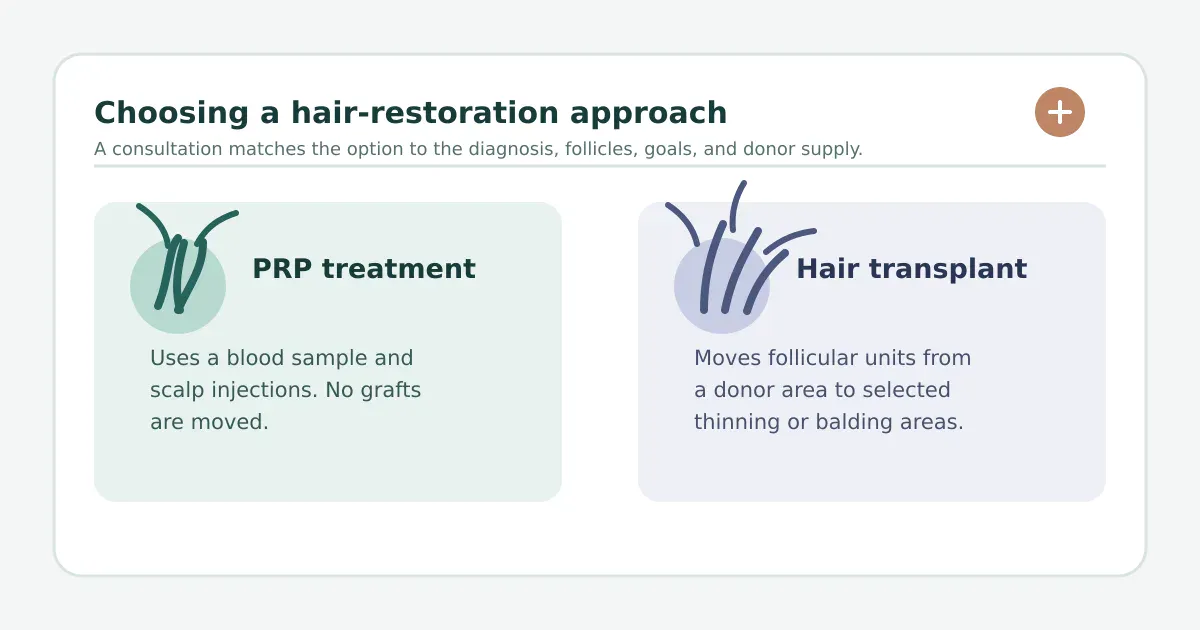
If you are comparing PRP hair treatment vs hair transplant, the two options address thinning in different ways. PRP uses a sample of your own blood and injections to support follicles that are still present. A transplant moves follicular units from a donor area to selected areas with thinning or baldness. Dermaclinique’s hair-loss treatment choices overview explains why diagnosis comes first. Neither option is automatically better. The right starting point depends on the cause and pattern of your hair loss, the health of your scalp, the amount of donor hair available, and the result you want.
Call (727) 888-0900 to discuss your hair-loss treatment choices
This guide compares the two approaches so you can have a more useful conversation with a board-certified dermatologist. It is not a diagnosis. Sudden shedding, round patches, scalp pain or inflammation, and rapidly changing hair loss deserve an evaluation before you choose a restoration procedure.
PRP Hair Treatment vs. Hair Transplant at a Glance
The simplest distinction is this: PRP is an injectable treatment that aims to support existing follicles, while a hair transplant is a surgery that redistributes follicles. That difference affects candidacy, downtime, the areas each option can address, and what you can reasonably expect from treatment.
| Consideration | PRP hair treatment | Hair transplant |
|---|---|---|
| What it does | Uses concentrated platelets from your blood and injects them into the scalp. | Moves follicular units from a donor area into selected thinning or balding areas. |
| Best suited to | Selected patients with thinning and follicles that may still respond to treatment. | Selected patients with a suitable donor supply, a healthy scalp, and a stable pattern that can be planned surgically. |
| Incisions or grafts | No grafts are removed or implanted. | Grafts are harvested and placed; FUE and FUT use different harvesting methods. |
| Downtime | Usually less disruption than surgery, though soreness, redness, or pinpoint injection marks can occur. | Requires surgical aftercare. Swelling, crusting, tenderness, and temporary shedding can occur while the scalp heals. |
| What it cannot promise | It cannot guarantee regrowth or create a new donor supply. | It cannot stop every future change in native hair or guarantee a particular density. |
A comparison table can help you frame the decision, but it cannot determine whether a treatment is medically appropriate. The first step is still a diagnosis. The American Academy of Dermatology explains why finding the cause of hair loss comes before choosing treatment.
How PRP Hair Treatment Works
During PRP treatment, a clinician draws a small sample of blood and processes it to separate the plasma and platelets from other blood components. The platelet-rich portion is then injected into areas of the scalp being treated. Platelets contain signaling proteins involved in the body’s repair processes, which is why PRP has been studied as a way to support hair growth in some forms of pattern hair loss.
Dermaclinique describes PRP for hair restoration as a nonsurgical approach. The visit does not involve removing a strip of scalp or implanting grafts. That may appeal to someone who wants an in-office option with less surgical disruption. It does not mean that the treatment is risk-free or that a nonsurgical approach is the right match for every type of alopecia.
Research on PRP for androgenetic alopecia has reported possible improvements in hair density and thickness, but protocols differ. Studies use different preparation methods, injection schedules, comparison groups, and ways of measuring results. A 2024 systematic review found potential benefit but also noted the low quality and variation of the available evidence. A realistic discussion should leave room for an incomplete or variable response.
PRP is most logically considered when the evaluation suggests that follicles remain in the area and may be supported. It is not a way to transplant follicles into a completely empty area. If hair loss is caused by an untreated inflammatory, infectious, autoimmune, nutritional, hormonal, or scarring condition, treating that cause may need to come before or instead of PRP.
How a Hair Transplant Works
A hair transplant redistributes your own follicular units. Hair is taken from a donor area, usually where growth is more resistant to the person’s pattern of loss, and placed into planned recipient areas. A surgeon considers the hairline, density, direction, caliber, color, scalp health, and the amount of donor hair that can be used without creating visible depletion.
Two common harvesting approaches are follicular unit excision, or FUE, and follicular unit transplantation, or FUT. In FUE, individual follicular units are removed with small punches. In FUT, a strip of scalp is removed and divided into grafts for placement. These are not interchangeable labels for the same procedure. The best approach depends on the patient’s anatomy, diagnosis, donor area, hair goals, and the surgeon’s plan.
Transplant surgery can add coverage to carefully selected areas where hair is significantly reduced. It does not create an unlimited supply of follicles. Donor hair is finite, and overharvesting can make the donor area look thinner. A good plan also accounts for the possibility that native hair may continue to thin around the transplanted hair. Medical treatment may be discussed to help manage that ongoing risk when appropriate.
The International Society of Hair Restoration Surgery’s FUE guidance emphasizes evaluating donor and recipient areas, scalp conditions, expectations, and the limits of available grafts. That is why a transplant should follow a careful consultation rather than a package or graft-count promise.
Who May Be a Better Fit for PRP?
PRP may be worth discussing when you have early or moderate thinning, a pattern consistent with androgenetic alopecia, and enough visible or miniaturized hair in the treatment area for a nonsurgical approach to make sense. It may also fit someone who wants to begin with an injectable treatment before considering surgery. A dermatologist still needs to confirm the diagnosis and explain what the treatment can and cannot do.
PRP may be a less useful first move when the loss is sudden, patchy, painful, scaly, scarred, or associated with signs of illness. Those patterns can point to conditions that need a different evaluation. It may also disappoint someone whose primary goal is to rebuild a sharply defined hairline or add coverage to a broad area with little remaining hair. The treatment works with the follicles that are there; it does not supply new grafts.
Ask about the complete plan, not only the injection itself. Useful questions include:
- What type of hair loss do you think I have, and what findings support that diagnosis?
- What result is realistic for my current density and pattern?
- How will we measure progress, and when will we reassess?
- Could medication, treatment of an underlying condition, or another option be more appropriate?
- What side effects, costs, and follow-up visits should I expect?
There is no universal PRP schedule that fits every patient. The preparation method, number of sessions, spacing, and follow-up should be explained by the treating clinician. Be cautious of claims that promise guaranteed regrowth, permanent results, or the same outcome for everyone.
Who May Be a Better Fit for a Hair Transplant?
A transplant may be considered when the diagnosis and pattern are appropriate for surgery, the donor area has enough usable hair, the scalp is healthy, and your expectations match what the available grafts can accomplish. Pattern hair loss is a common reason to consider transplantation, but a person with hair loss is not automatically a surgical candidate. Stabilizing active loss or treating scalp disease may be important first.
A consultation should include more than a look at the thinning area. The surgeon should examine the donor zone, discuss how much hair may be available over time, review the likely pattern of future loss, and talk about your preferred hairline and density. Age, family history, prior procedures, medications, and the diagnosis all affect planning. The goal is not simply to fill today’s empty-looking area; it is to create a plan that remains natural as your hair changes.
Transplant surgery may be a poor fit if the donor area is too limited, loss is still rapidly progressing, the scalp has an untreated condition, or expectations exceed the available supply. A person may also prefer to avoid surgery, incisions, or a longer recovery process. In those situations, diagnosis-based medical care or an injectable approach may be discussed instead. A responsible consultation can recommend against surgery when the risk of an unsatisfying result is too high.
Recovery, Risks, and Results
PRP recovery and risks
PRP generally involves less procedural disruption than a transplant, but you can still have tenderness, redness, swelling, bruising, or small injection-site marks. Infection and bleeding are possible with any injection. Your clinician should review your health history, medicines, allergies, and any reason the procedure may not be appropriate for you.
Hair changes are gradual, and a response is not guaranteed. Take progress photographs under similar lighting if your clinician recommends them. Do not judge the treatment by a single day of shedding or by a heavily edited before-and-after image. If pain, redness, drainage, or other symptoms are worsening rather than settling, contact the treating office.
Transplant recovery and risks
After a transplant, the scalp needs time to heal. Swelling, tenderness, crusting, and temporary shedding can occur. The transplanted hairs do not provide an instant final result; growth and maturation take time. Your surgeon will give specific instructions about washing, physical activity, sun exposure, medicines, and follow-up. Follow those instructions instead of copying a recovery plan from a social-media post.
Risks can include bleeding, infection, scarring, an unnatural hairline, poor growth, changes in sensation, and visible depletion of the donor area. FUE can leave small scars, and FUT leaves a linear donor scar. Neither technique is truly scar-free. Results vary with diagnosis, donor characteristics, surgical planning, technique, healing, and future loss.
PRP and transplant surgery can sometimes be discussed in the same long-term plan, but combination treatment should not be assumed to be necessary. Evidence for PRP as an addition to transplant surgery is still developing, and protocols vary. Your clinician can explain whether a combined approach has a clear reason in your case.
How to Choose Between PRP and a Hair Transplant
Use the following sequence to make the decision more carefully:
- Confirm the diagnosis. Hair loss from pattern change, temporary shedding, alopecia areata, traction, infection, or scarring does not have the same treatment plan.
- Clarify the goal. You may want to slow loss, support existing density, soften a part, restore a hairline, or add coverage. Each goal changes the discussion.
- Assess the donor area. A transplant depends on usable donor hair. PRP does not create donor hair, but it also does not require harvesting it.
- Compare the tradeoffs. Consider surgery, recovery, possible scars, repeat visits, uncertainty, cost, and how much change you hope to see.
- Plan for the future. Native hair may continue to change. Ask how the plan accounts for future thinning and what follow-up may be needed.
Start with Dermaclinique’s hair-loss treatment choices overview to understand the broader evaluation and restoration options. The practice also provides information about PRP for hair restoration and hair transplant planning. Those pages are useful starting points, but a page cannot determine candidacy without an examination.
Frequently Asked Questions
Is PRP better than a hair transplant?
Neither is better for every patient. PRP is an injectable treatment that supports existing follicles and avoids graft harvesting. A transplant redistributes follicles and may provide coverage in selected areas with significant thinning or baldness. The diagnosis, donor supply, goals, tolerance for surgery, and expected future loss determine which option is more appropriate.
Can PRP replace a hair transplant?
PRP does not replace a transplant when the main goal is to move follicles into an area with little or no remaining hair. It may be considered for selected thinning when follicles are still present. It can also be part of a broader plan in some cases, but it cannot create an unlimited supply of new follicles or guarantee the density a patient has in mind.
Does a hair transplant stop future hair loss?
No. A transplant moves selected follicles, but the native hair around them may continue to thin. The long-term plan may include monitoring and diagnosis-based medical treatment when appropriate. Ask how your clinician expects your pattern to change and how that possibility affects the hairline, donor supply, and timing of surgery.
Is PRP treatment painful?
PRP requires injections into the scalp, so you may feel brief pinching or pressure and have soreness afterward. Comfort measures vary by office and patient. Tell the clinician about your concerns before treatment. Pain that is severe, worsening, or accompanied by signs of infection should be reported to the treating office.
How long does it take to see hair-transplant results?
Transplant results develop gradually rather than appearing immediately. The scalp heals first, and transplanted hairs may shed before new growth becomes visible. The timing and final appearance vary with the procedure, healing, graft characteristics, and the patient’s pattern of loss. Your surgeon should set a follow-up schedule and explain what changes are expected at each stage.
What should I do before choosing either treatment?
Schedule a hair-loss evaluation and bring a list of medicines, supplements, recent illnesses, major weight changes, family history, and prior treatments. Bring photographs if the change has been gradual. A dermatologist can examine the scalp, confirm whether the pattern fits a restoration approach, and explain whether PRP, transplant surgery, medical care, or a combination makes sense.
Discuss Your Hair-Restoration Options
The decision between PRP hair treatment and hair transplant surgery should follow a diagnosis and a realistic discussion of goals. PRP may suit selected patients who want a nonsurgical treatment for thinning with existing follicles. A transplant may suit selected patients who have an appropriate pattern, a healthy scalp, enough donor hair, and a goal that requires redistribution of follicles. Sometimes the best answer is to treat the cause first and revisit restoration later.
Call (727) 888-0900 to schedule a hair-loss consultation in St. Petersburg or Clearwater
Dermaclinique is a physician-owned dermatology practice serving patients in St. Petersburg and Clearwater. A consultation with Dr. Priya Nayyar can help you compare options based on your scalp, hair pattern, donor supply, and priorities rather than a generic promise.